01
Neural / Generative AI
Interprets unstructured inputs and proposes candidates.
A proposal is not an approved engineering answer.
Logic & Technology
METOMOS does not treat every layer as the same kind of AI. Each task goes to the system—or person—best suited to do it, and the handoff between them remains traceable.
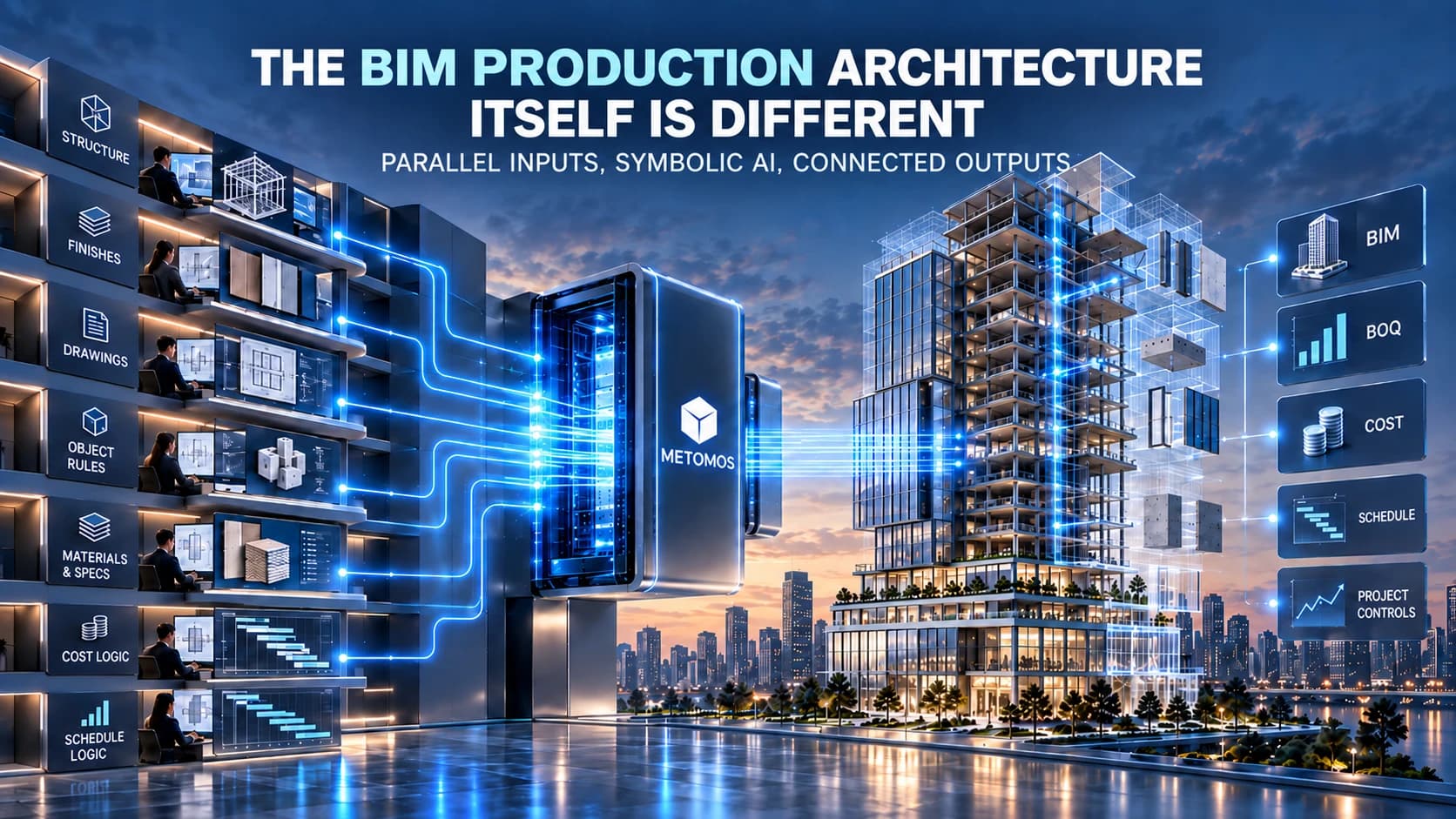
Four distinct responsibilities
01
Interprets unstructured inputs and proposes candidates.
A proposal is not an approved engineering answer.
02
Keeps object meaning, relationships and constraints explicit and inspectable.
It does not remove ambiguity that needs professional judgment.
03
Calculates quantities, costs and affected states from controlled inputs.
Results remain conditional on input quality and agreed rules.
04
Reviews ambiguity, exceptions, assumptions and delivery standards.
Responsibility stays visible instead of being hidden behind automation.
Engineering software
All eight are existing software programs with working functions in their respective fields, usable today. Their next step is to modernize the visual interface and graphics, not to build their core functions from scratch. Project-specific integration and delivery scope are defined separately. Unlike the three planned programs below, these eight are not future-development concepts.
2D design drafting
A drafting entry point for third-party CAD environments, with MetomLISP support where agreed.
Preliminary cost · structure, finishes, earthwork
Supports preliminary estimating before complete drawings exist. A historical ±5% tolerance applies only to documented deliveries with defined scope and inputs, not every project.
Finish quantity · logical 3D
Connects finishing quantities with the project’s spatial and specification context.
Frame quantity
Supports detailed structural quantity work, including rebar-related information.
Bill of quantities · cost
Organises quantity and cost information for the required estimate and bid formats.
Quantity-connected 3D
Connects verified quantity information with 3D views for relationship and clash review.
Cost · schedule performance
Presents CPI and SPI from connected cost, schedule and progress records.
Sequence · spend simulation
Reviews 3D sequence, schedule states and period cost on a shared timeline.
Expansion modules
These are future development plans, not currently available software.
2D and 3D
2D drawings remain essential contractual and working documents. 3D views make spatial relationships easier to inspect. METOMOS connects their shared references and engineering context instead of declaring either one obsolete.
Likewise, 4D is not simply another geometric dimension. It connects time, activity and state to the engineering information being reviewed.
3D · 4D · 5D BIM
The terms are used loosely across the industry. At METOMOS each dimension is a connection, not a picture: the same engineering objects, read against geometry, then time, then cost, then the rest of the lifecycle.
3D
Every building element is an engineering object with its own identity, geometry, material, classification and the properties its quantity depends on — traceable back to the drawing it came from. A model that only looks right is a visualization, not 3D BIM in our sense.
4D
Those objects are linked to construction activities, sequence and dates. On any date the model can show the state the building should be in — and, with progress recorded, the state it is actually in, side by side.
5D
The same objects carry quantity, BOQ item and unit cost, so cost is available per object, per activity and per period. That is what makes cost traceable to the design — and what EVMS is calculated from.
xD
METOM xD BIM carries the same objects forward into progress, change history, as-built and operational data, so the model at completion is the building's verified engineering record rather than a model rebuilt for handover.
So 4D is not an animation, and 5D is not a spreadsheet attached to a model. They are the same engineering objects read against time and cost — which is why a design change can move through all of them together.
Connected change propagation
01
Receive the change and its source
02
Validate scope, version and approval state
03
Identify related objects and affected outputs
04
Recalculate the affected quantity, cost and schedule states
05
Review exceptions and professional judgments
06
Publish the verified project state with traceable evidence
This is not a promise that one edit blindly changes everything. Only affected states are recalculated, and judgment or exceptions remain available for review.
LOD
LOD describes how developed and reliable model information is for an intended use at a project stage. A higher label does not by itself guarantee photorealism, dimensional accuracy or fitness for every downstream task.
Foundry delivery can include LOD 400-class fabrication, assembly or installation information where the agreed scope requires it. Richer or verified as-built information is defined and accepted project by project.
Evaluate the logic in context