Construction Engineering Data Foundry
You design the project. The Foundry manufactures the engineering data.
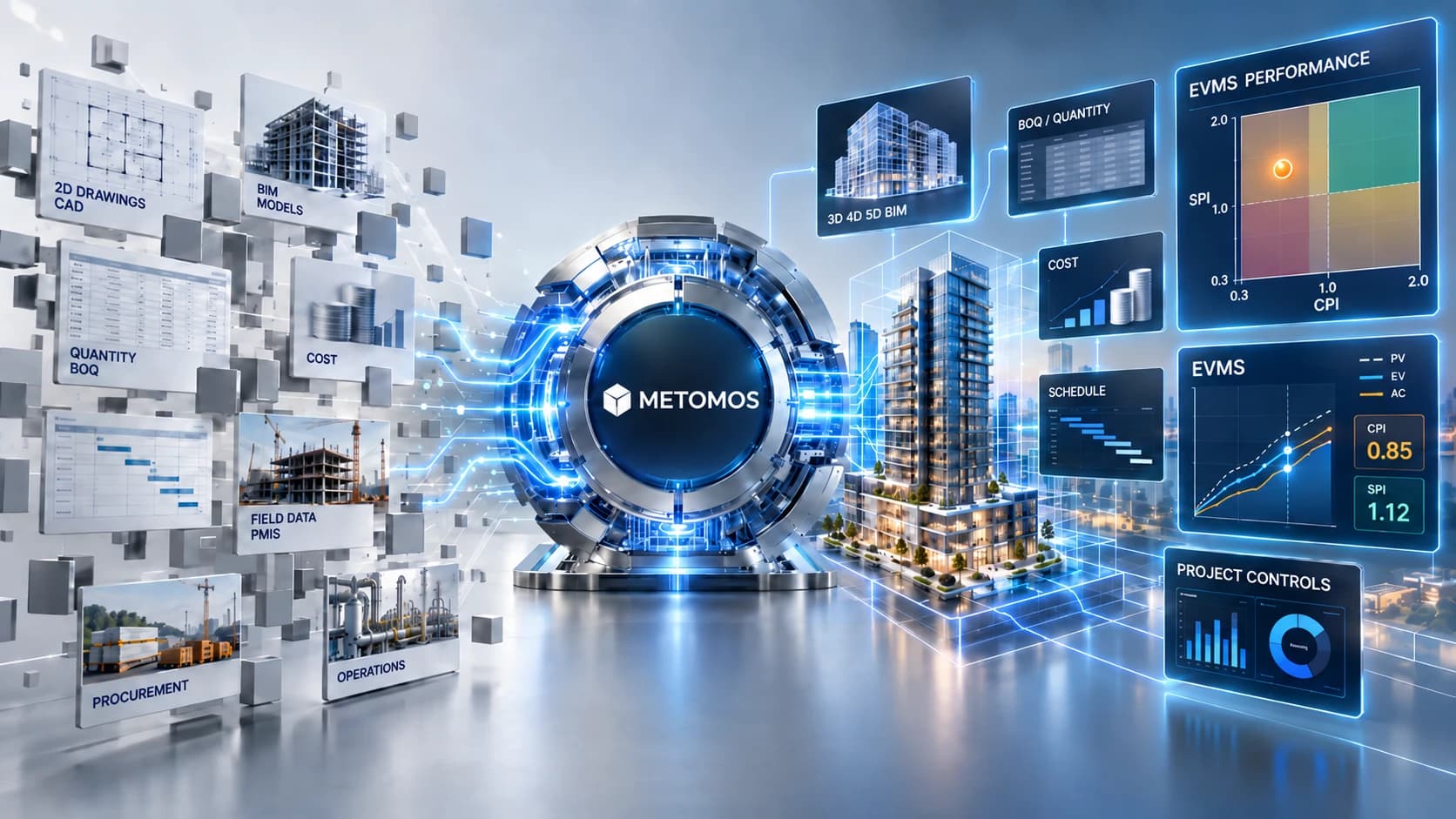
From your drawings and requirements, METOMOS produces 3D BIM, quantity, BOQ, cost, schedule and EVMS-ready data as one connected engineering state — full integration, not files kept in step by hand. Work that conventionally takes about 30 days is delivered in about 4.
Change the design once and the connected impact is recalculated, verified and delivered — design change stops being something to fear. Near-real-time EVMS is the proof that the integration underneath is real.
Software is a tool. Verified engineering data is the product. Scope, delivery and turnaround are defined per project, and results pass expert review before they are handed over.
What the Foundry does
Connected engineering data, produced for you — the way a foundry produces chips.
A chip designer does not have to build its own fab. It hands its design to a foundry that runs the specialised production. METOMOS applies the same production logic to construction engineering data: you provide the project, and the Foundry returns connected, verified engineering data as a contracted service.
No client organization has to rebuild the same specialist production workflow internally — or hire its way through every peak.
Software is a tool.
Verified engineering data is the product.
The product is not another software license for your team to operate. It is usable engineering data, delivered.
You provide
The METOMOS Foundry
You receive
Full integration, not partial integration
BIM ↔ cost and BIM ↔ schedule links exist everywhere. METOMOS keeps one object's identity and engineering meaning across design, BIM, quantity, BOQ, cost, schedule, progress and evidence — one engineering state, not many connected files.
Parallel, not a relay race
Outputs do not wait for the one before them to be handed over. BIM, quantity, cost and schedule are produced around the same engineering state at the same time.
Change without fear
Change once. Update the connected impact. Verify. Continue. A design change is traced to the quantities, costs, activities and schedule it affects, instead of every downstream document being rebuilt by hand.
Proof you can see: near-real-time EVMS
EVMS cannot stay current unless scope, quantity, cost, schedule and progress are genuinely connected. That it does is the visible proof of the integration underneath.
Depending on the engagement, delivery may include
Speed
Not just faster BIM. Faster usable engineering data.
The advantage does not come from drawing faster. It comes from parallel engineering: the outputs are produced around one engineering state instead of waiting in line for each other, and people verify instead of rebuilding.
BIM & connected engineering delivery
Conventional equivalent delivery vs. METOMOS
Large scope
Conventional equivalent delivery vs. METOMOS
Quantity & estimating
BIM, quantity, BOQ and cost, with 3D Viewer verification
Examples from delivered METOMOS work, compared with the conventional equivalent for the same scope. Turnaround on your project depends on its scope, input quality and acceptance standard, and is agreed before work starts.
Quantity Surveyors & Cost Estimators
Let experts verify. Don't make them rebuild the data.
METOMOS does not replace the quantity surveyor. It multiplies what one surveyor can deliver. The estimator receives BIM, quantity, BOQ and cost together with a 3D Viewer — and sees not just “concrete = this many m³” but which objects, floors and design state the number came from.
Manual production
- 01Read
- 02Measure
- 03Count
- 04Re-enter
- 05Reconcile
- 06Verify
20+ days on a large takeoff
Engineering verification
- 01Receive
- 02Visualize
- 03Verify
- 04Adjust exceptions
- 05Approve
~2–3 days, with 3D Viewer verification
When engineering information arrives earlier, the business moves faster.
Faster bids
Quantity, cost and schedule for an opportunity are ready in days, so the same team can evaluate and bid on more projects.
Earlier cost decisions
“How much will this building cost?” is answered from BIM, quantity and cost together — while the design can still respond.
More project capacity
An estimating office or contractor that finishes equivalent work several times faster can carry more work with the same organisation.
Faster project control
Cost, schedule and progress move together, so control decisions are made on current information instead of last month's report.
How the work is organised
Two ways to produce the same six things.
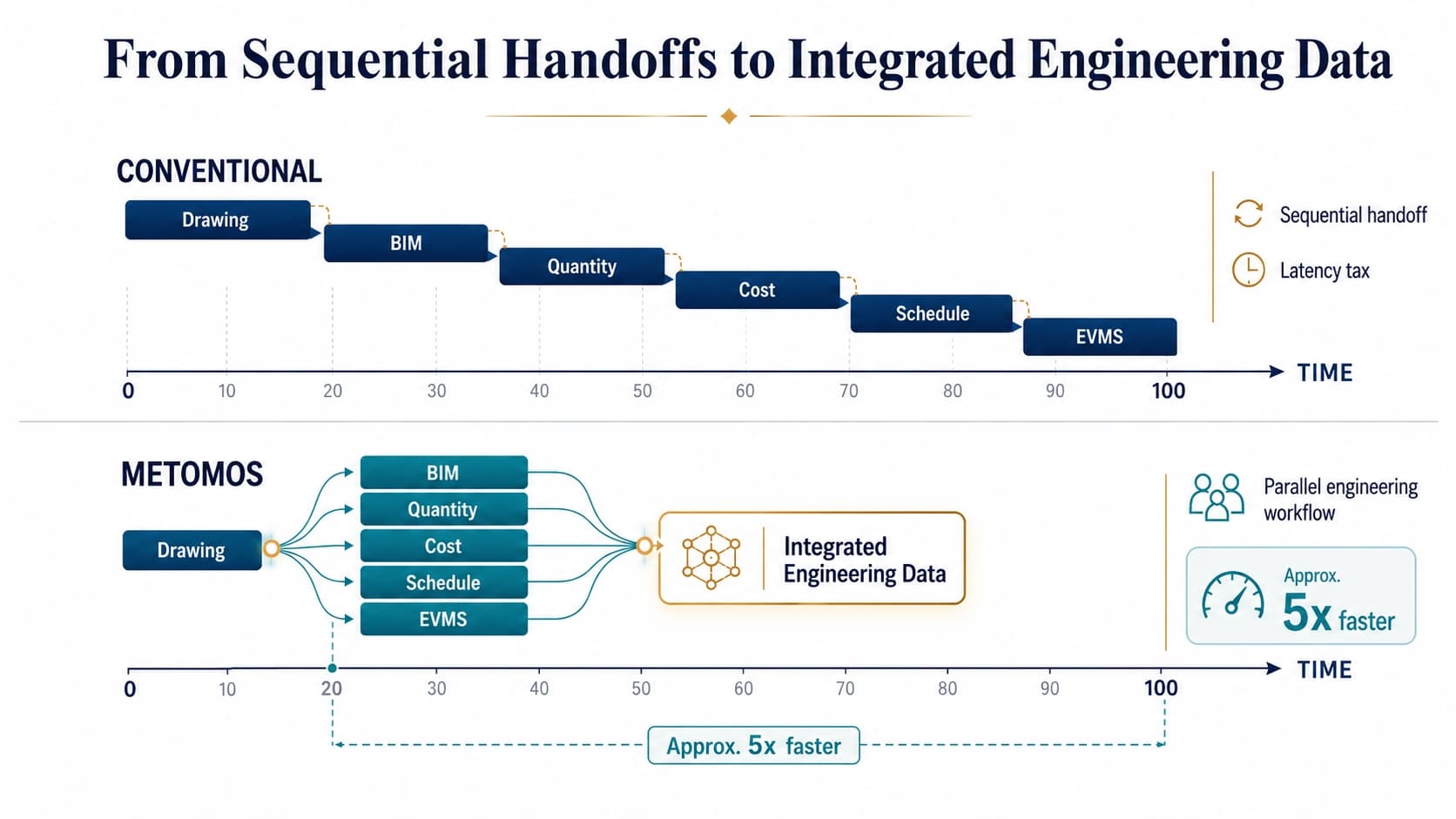
A project needs a model, quantities, cost, a schedule and performance data. Conventionally each one waits for the one before it: the model has to be finished before quantities can be measured, quantities before cost, cost before the schedule can be priced. The work is not slow because any single step is slow. It is slow because the steps are queued.
When the five outputs are read from one shared engineering state instead of from each other, the queue is no longer necessary.
The top row — conventional
Each box starts only when the one before it has been handed over. The gaps between the boxes are not idle time — they are re-entry, reinterpretation and reconciliation. EVMS arrives last, which is why performance figures describe a situation that has already moved on.
The bottom row — METOMOS
The five outputs fan out from the same drawing-derived engineering state and converge again as one connected dataset. They are not copies of each other kept in step by hand; they are views of one thing. When that state changes, the affected views can be recalculated against the verified change.
What makes parallel delivery credible
Parallel work only creates value when its outputs remain aligned. METOMOS therefore treats source control, connected engineering context, production and review as one accountable delivery system rather than a relay of disconnected files.
The project scope, source set and acceptance standard are defined before production begins.
Required outputs retain shared object identity, relationships and engineering meaning.
BIM, quantity, cost, schedule and project-control outputs can be produced from the same engineering state without waiting for a complete file handoff at every step.
Exceptions remain visible to human review, while sources, versions and approvals travel with the result.
The result is not automatic approval. Calculable changes can move faster, while engineering judgment, exceptions and acceptance remain visible to responsible people.
About the figure in the diagram. The diagram reflects delivered work. In confirmed examples, connected engineering delivery that conventionally takes about 30 days was completed in about 4, a larger scope of about 60 days in about 7, and a 20-plus-day quantity takeoff in about 2–3 days with 3D verification. To see it on your own project, run a same-scope benchmark: one agreed scope, one input set, your conventional baseline beside ours, with delivery time, man-hours, accuracy and change response measured on both.
Capabilities
Connected capabilities across the project lifecycle.
Design & Preconstruction
Structure design and project information so estimating, BIM/VDC and engineering work can use it directly, without changing how your team designs.
Quantity & Cost Intelligence
Connect engineering information with quantity take-off, BOQ and cost management, so cost data stays consistent and can be checked back to its basis.
3D / 4D / 5D BIM
Connect spatial models with quantity, cost and time-based project information for visualization, verification and project decision support.
Project Controls & EVMS
Bring cost, schedule, progress and performance into one connected context for clearer monitoring, forecasting and decisions.
Change Intelligence
Understand how a design or engineering change affects the connected quantity, cost, schedule and execution information around it.
Lifecycle & Digital Twin Data
Extend verified project information toward as-built, operational and lifecycle use, giving a digital twin something to stand on.
The proof of integration
Near-real-time EVMS is the proof that the integration is real.
Many companies say they integrate BIM. EVMS is where that claim is tested. Earned value cannot stay current unless scope, quantity, cost, schedule and progress all refer to the same work. In a partially integrated project, someone rebuilds that mapping by hand every month. In METOMOS it is already there — so the numbers stay current.
METOMOS shows the integration instead of claiming it — through two views of the same data.
CPI / SPI
Numerical project performance
4D planned vs actual
Visual project performance
One project. Same data. Two ways to see the truth.
Why METOMOS can do thisEVMS in practice
The calculation is established. Keeping its inputs current is the hard part.
Earned Value Management compares three things: what you planned to have finished by now, what you have actually finished, and what it cost. From those it derives whether the project is ahead or behind, and whether it is spending more or less than the work is worth.
The arithmetic is not the difficulty. The difficulty is that the three numbers come from five systems that were never built to agree with each other.
What this example shows
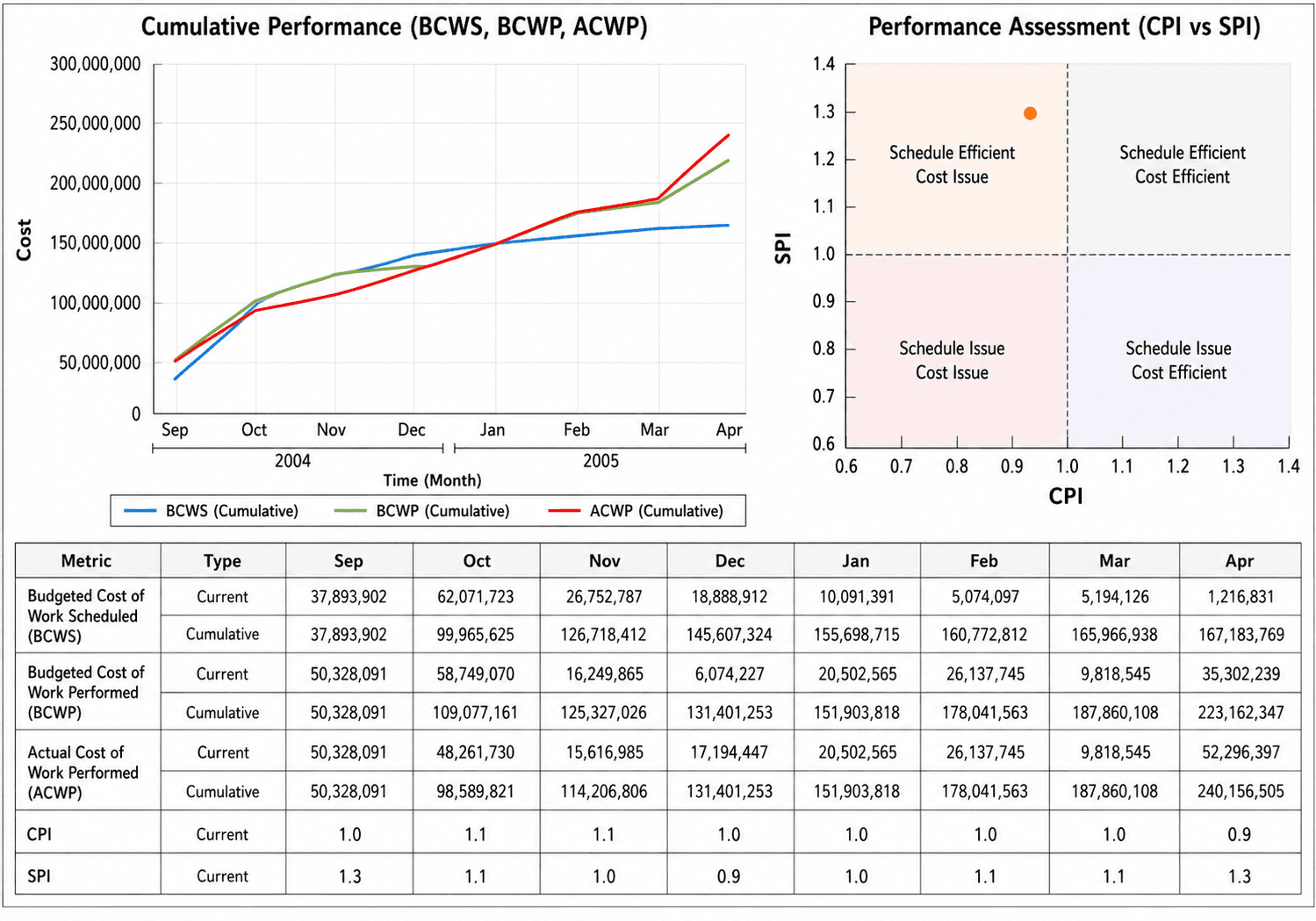
The green earned-value line and the red actual-cost line track each other for most of the year, then separate: the work being completed is worth less than what is being spent on it. The quadrant chart puts the same story in one dot — the schedule is fine, the cost is not. Both readings come from the monthly table below them.
The question that matters
Not whether a report like this can be produced — it can, everywhere. The question is how old the numbers are by the time you read them, and how long it takes to redraw the picture after the design changes. That interval is where the money is.
Why the cycle is monthly
The inputs live in different places
Scope sits in the model, quantities in the take-off, budget in the estimate, dates in the schedule and progress in field reports. Before an index can be calculated, someone has to gather all five and agree they describe the same work.
Reconciliation is manual
Work packages, cost codes and activities rarely line up one-to-one across systems, so the mapping is rebuilt by hand each cycle — and rebuilt again after any change.
So the cycle is monthly, and it looks backwards
By the time the indices are agreed, they describe a project state that has already changed. EVMS becomes a reporting obligation rather than an instrument you steer with.
What changes here. Scope, quantity, cost, schedule and progress already share one object identity, so the mapping between them is not rebuilt each cycle — it is already there. After a change or a progress update, the affected figures can be recalculated against that same state rather than re-gathered. EVMS moves from something you report to something you can steer with.
The build-it-yourself question
What an organisation would have to assemble to reach the same standing.
We are deliberately not quoting a price for this. What it would cost depends on where an organisation starts, and a number we invented would be worth less than an honest list of what has to exist. Three of these four can be bought with budget and time. The fourth cannot.
Cross-domain integration
Design, BIM, quantity, cost, schedule and EVMS have to share one stable engineering meaning. Each discipline is a specialism on its own; the hard part is the joins between them, where ownership is often divided across teams.
Reproducibility
Producing numbers fast is not enough — the same inputs must give the same answer tomorrow, and each figure has to carry the source, rule and approval that produced it. That is an engineering discipline, not a feature.
Exception knowledge
Written rules cover the ordinary case. Real projects generate the rest: odd geometry, contested deductions, corrections, site decisions. This knowledge is not purchasable — it accumulates one project at a time.
Verified project history
The part that cannot be shortened. Rules, exceptions, calculations, approvals and change events only become trustworthy after they have been applied, contested and corrected on real work.
This is also why our answer to a sceptical reader is a defined scope rather than an argument: put one agreed package through your workflow and ours, and compare what comes out.
The METOMOS Approach
One engineering data thread.
Instead of treating 3D models, quantities, costs, schedules and progress reports as isolated outputs, METOMOS connects them through a consistent engineering context — so project information is produced, verified, updated and reused rather than rebuilt at every handoff.
Lifecycle & Digital Twin
BIM should not die after modeling.
Because the model stays connected to quantity, cost, schedule and progress through execution, it accumulates the project's design, change, cost, schedule and progress history. At completion it is not a picture of the building. It is the building's verified engineering record.
That is the difference between a digital twin that only looks right and one that machines can act on.
Now
As-built lifecycle data
Verified as-built objects, quantities, costs and change history carried into operation and maintenance as lifecycle data — not a model rebuilt for handover.
Extending
A spatial world for Physical AI
Engineering data precise and meaningful enough for Physical AI to use as its spatial world: what each object is, where it is, what it is made of and which state it is in.
Future direction
A coordinate-synchronized twin for construction robots
A digital twin whose coordinates are synchronized with the site, so construction robots can locate, place and build from the same verified engineering state the people on the project use.
Stages marked “extending” and “future direction” describe where the Foundry's data is being taken, not services available today. Machine use of project data is validated task by task.
Why this is still unsolved
Construction has advanced. BIM has advanced. The data between them still breaks.
Construction itself has advanced
BIM software has advanced too
Yet it never got manufacturing's digital thread
Because every project is different — and keeps changing
A car factory does not redesign the car for each car on the line. Construction designs a one-off product and builds its factory at the same time, and both keep changing until handover.
Manufacturing
Design once. Repeat production.
- A stable product definition
- Repeatable process, controlled environment
- 3D CAD · BOM · PLM · ERP · MES
- A digital thread that stays put
Construction
Design and execution keep changing each other.
- A unique project on a unique site
- Different owners, designers and contractors every time
- Different soil, rules, materials and methods
- A temporary factory that changes, then disappears
05So the human is still the middleware
The software is digital.The handoff is still human.
Between every pair of tools sits a specialist who interprets, validates and reconciles — who decides whether this wall, this quantity, this cost item and this schedule activity are the same object in the same project state. Email, Excel, PDF, a shared cloud or an API can move the file. None of them decides that.
06Partial integration
BIM ↔ cost, BIM ↔ schedule, ERP ↔ PMIS: partial integrations are everywhere. But when the design changes, people still re-align every link by hand — which is why one wall can cost days of downstream coordination, and one miss becomes rework, a wrong order or a wrong payment.
What METOMOS changes
METOMOS moves the connection inside the engineering state
Experts stop producing and start verifying
That is why the timelines collapse
And the integration is shown, not claimed
Not a fast BIM company.An Engineering Data Foundry that removes the human handoff bottleneck.
The Hidden Cost of Disconnection
Six taxes paid whenever project data breaks apart.
Repeated entry, waiting, scarce expertise spent on reconciliation, lost meaning, reconstructed evidence and eventual disputes are not separate inconveniences. They are recurring project costs.
01
Re-entry Tax
Teams re-enter the same information, rebuild mappings, remeasure quantities, recode estimates, reconnect activities and reproduce reports.
02
Latency Tax
Teams wait for periodic reconciliation, then spend additional time locating which reports and models are current.
03
Expertise Tax
Senior time is consumed by checking identifiers, copying values, resolving version confusion and preparing the same evidence again.
04
Semantic Tax
People rebuild the meaning of each object at every handoff and manually decide which records refer to the same thing.
05
Evidence Tax
The team searches emails, old models, spreadsheets, approvals and meeting records to reconstruct the basis after the fact.
06
Dispute Tax
Time moves from delivery into claims preparation, responsibility arguments, contractual interpretation and legal review.
Engineering Ground Truth
From digital information to engineering ground truth.
A digital model is valuable only when its engineering meaning can be trusted. So METOMOS focuses on information that can be connected to its source, its context, the basis it was calculated on, its version and its verification history.
That is a stronger foundation for BIM/VDC, cost management, project controls, digital twins and the machine-readable engineering environments coming next.
Here, engineering ground truth means the approved project state people can work from: objects, quantities, costs, rules, versions, sources and verification—not merely one number or one model.
Human + System Validation
Automation with engineering accountability.
Engineering automation should not hide uncertainty. METOMOS combines systematic processing of repeatable engineering work with human review wherever professional judgment, exceptions or approval are required.
The objective is not to remove engineering professionals from the process. It is to increase the amount of reliable work that specialists can review, validate and deliver.
Where METOMOS Sits
Generative AI proposes.METOMOS proves.
The two are not competitors. Generation expands what can be considered. Symbolic AI makes engineering meaning, relationships and constraints explicit; deterministic calculation and Human Verification turn one option into a decision an organisation can check and accept.
A proposal is an option
Generative tools are good at producing candidates quickly — layouts, alternatives, drafts, narratives. That is genuinely useful at the front of a project, when the point is to widen the field of what could be built.
A commitment needs proof
A plausible answer is not enough to approve a budget, a schedule or a claim. Before a number leaves the building it has to carry its basis: what it was calculated from, which version, under which assumptions, and who checked it.
This is why METOMOS invests in the unglamorous half. Proposing is getting cheaper every year. Proving is what construction has always been short of.
Interoperability
Designed to work with the construction technology stack you already have.
Construction companies have already invested in CAD, BIM, ERP, PMIS, scheduling and digital-delivery environments. METOMOS is designed around interoperability rather than around replacing them — through controlled integration and data exchange, it complements existing workflows while keeping one consistent engineering context underneath.
Integration scope is defined per engagement. We do not claim certified integration with any specific vendor product.
Industries
Where connected engineering data matters most.
Buildings & Construction
Design, quantity and cost that stay connected from feasibility through construction.
Infrastructure
Change control and traceable quantities that hold up over years, not weeks.
Industrial Facilities
Facilities where engineering, procurement and construction information must stay aligned.
Semiconductor Fabs
Thousands of connected engineering decisions across design, quantity, cost, schedule, utilities and execution, with a way to see how a change moves through them.
Data Centers
Repeatable build programs where cost, schedule and change data must be comparable across sites.
Complex Capital Projects
Programs where owners, contractors and consultants must work from the same project reality.
Who We Build For
Built for the organizations that deliver complex projects.
Track Record
Three decades of engineering software, sold and used on real projects.
The engineering software and domain logic behind METOMOS has been developed over three decades and used on real projects by major construction firms, manufacturers and research institutions in Korea and abroad.
Specific organization references are shared privately with parties in active discussion, under confidentiality. Ask your METOMOS contact for access.
Start Here
Start with proof.
The most effective way to evaluate METOMOS is on a defined project scope. We agree the scope, the deliverables and the review together, and you judge the result against the engineering standards you already hold your own work to.
What we can be judged on
Symbolic AI · Physical AI
AI can generate possibilities. Construction needs context it can trust.
Symbolic AI makes the meaning, relationships and constraints in engineering information explicit. Deterministic calculation and Human Verification then make the resulting project state traceable and accountable.
Future agents, robots and eventually AGI may perform more of today’s integration work. METOMOS is not claiming to build those systems; it is developing the machine-usable engineering context that connects what people need now with what more capable AI will need to act safely later.