Why METOMOS
Construction already has excellent digital tools. The hidden cost is keeping their engineering meaning aligned.
Specialized tools and teams can produce sophisticated results. Yet the same project is still reinterpreted across drawings, BIM, quantity, cost, schedule, progress and evidence. METOMOS changes that production architecture so these outputs can be connected, updated and verified with less sequential reconciliation.
01 · Why BIM matters
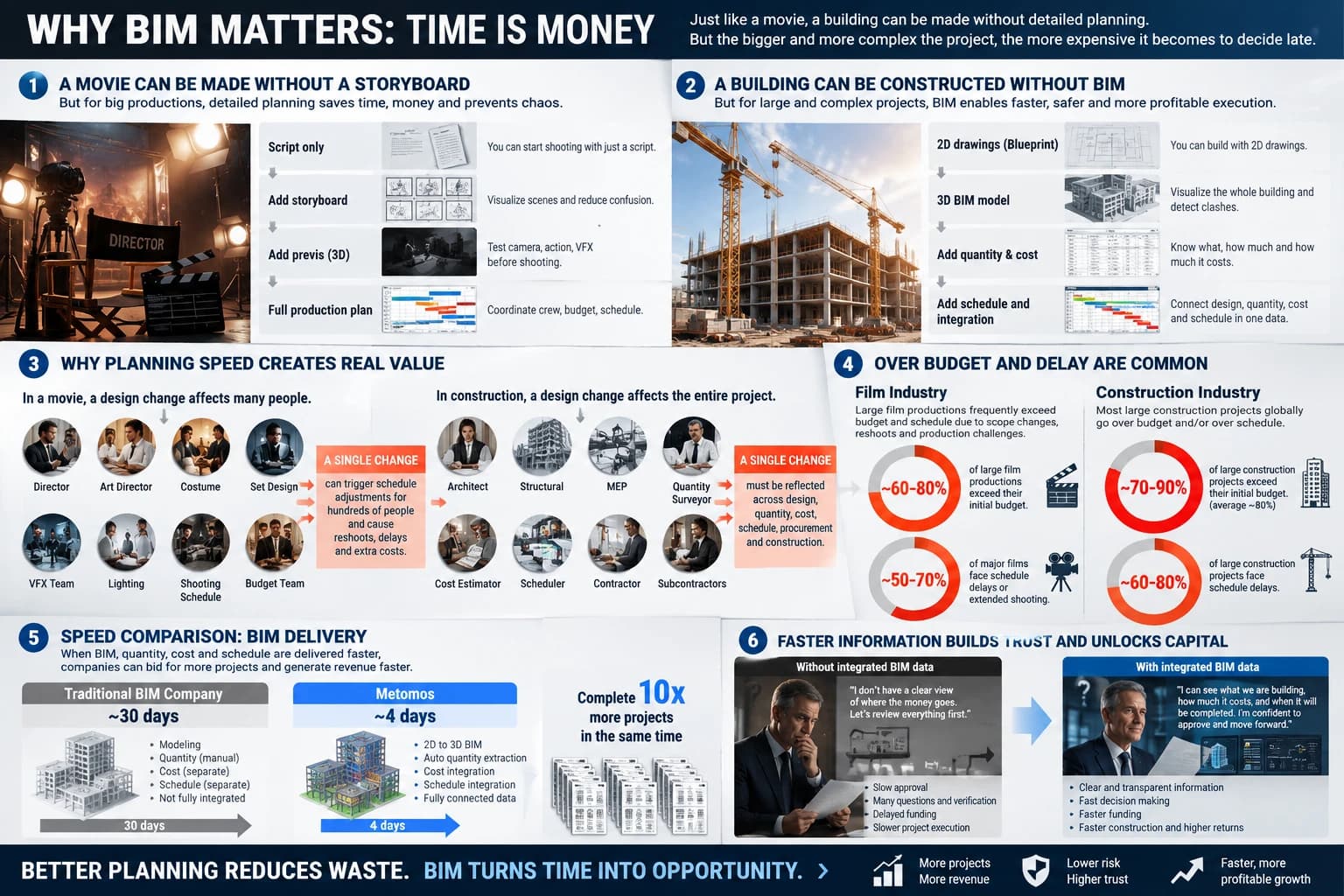
A building can be built without BIM. That is why its value is so easy to miss.
A film can be shot from a script alone, and a building can be built from 2D drawings. But the larger the production, the more every late decision costs — and one change ripples through many people. In construction it runs through design, quantity, cost, schedule, procurement and the site.
BIM earns its value when it becomes earlier decisions: what is being built, what it will cost and when it will be done — known before the money and the time are committed.
02 · The real bottleneck
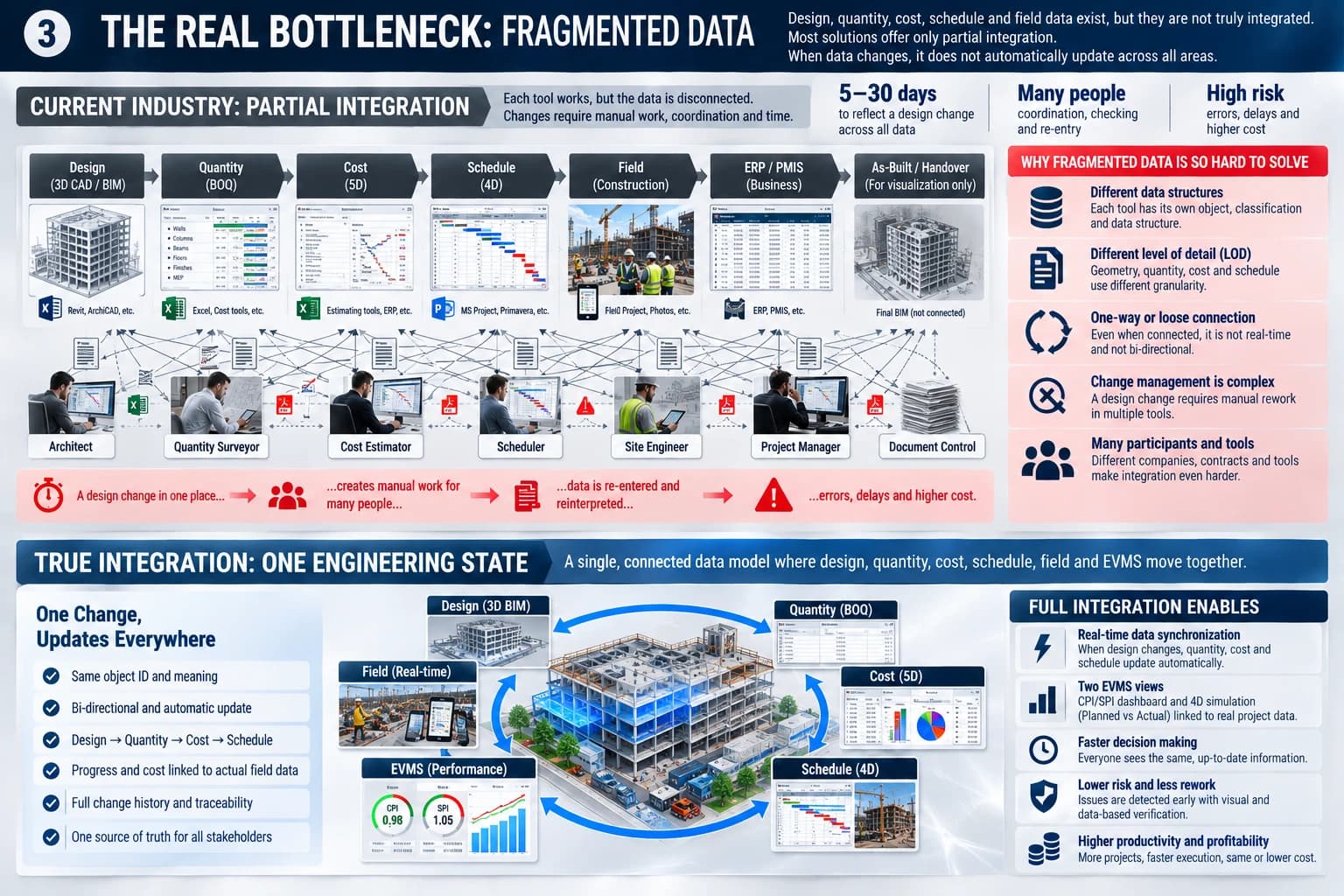
The tools work. The data between them does not.
Design, quantity, cost, schedule, the field and ERP each have capable software. But each keeps its own objects, its own level of detail and its own classification. So a change in one place becomes manual work for many people: re-entered, reinterpreted and rechecked.
The answer is not one more connection between tools. It is one engineering state in which the same object keeps the same identity and meaning everywhere — so one change updates everything it affects.
03 · Today vs. METOMOS
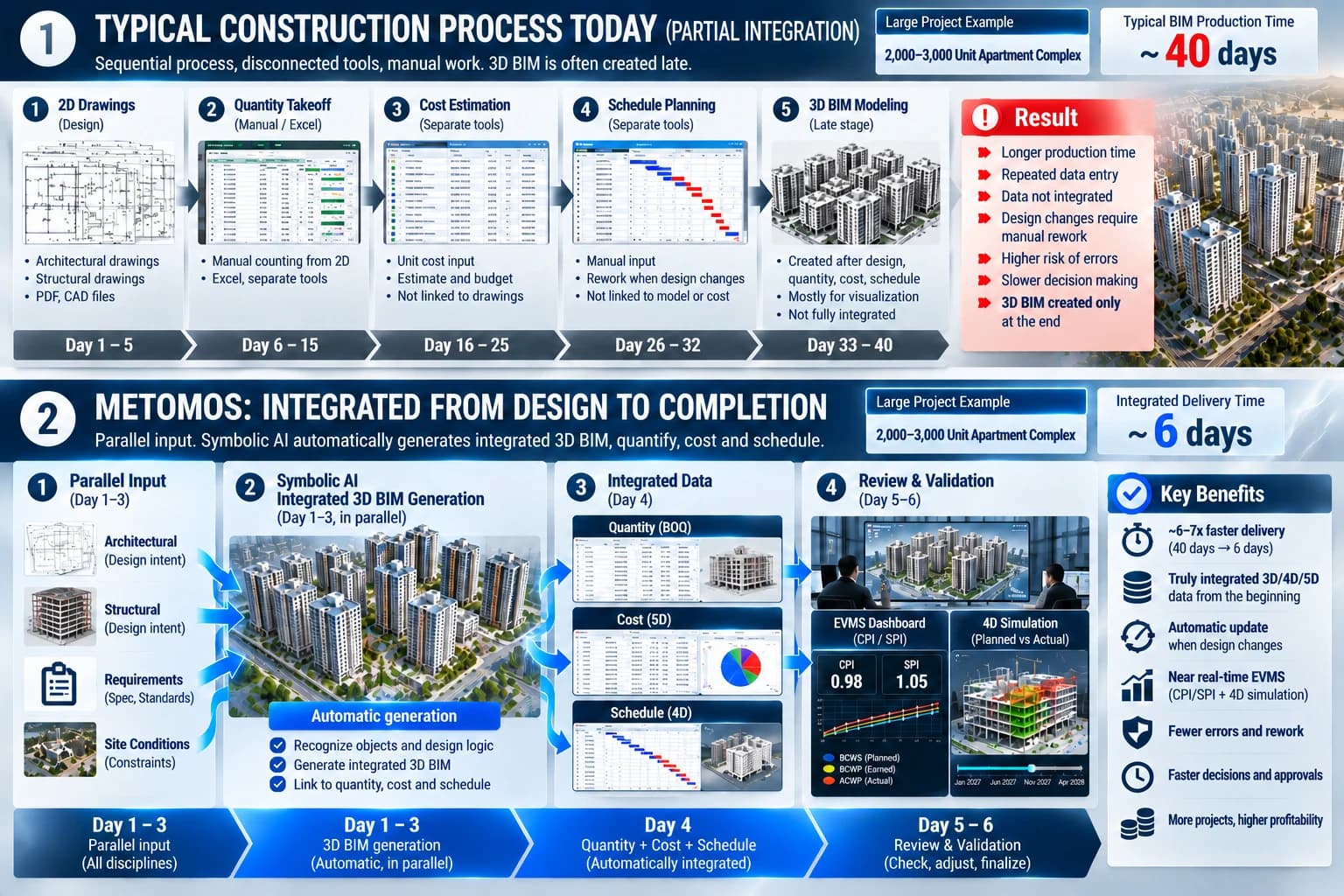
A relay of about 40 days, or parallel production in about 6.
In the large-project example shown — a 2,000 to 3,000-unit apartment complex — the usual sequence runs drawings, takeoff, estimating, scheduling and finally 3D BIM, each step waiting for the last. The model arrives at the end, mostly for visualisation.
METOMOS takes the inputs in parallel and produces BIM, quantity, cost and schedule around the same engineering state, so experts review and validate on days 5 and 6 instead of rebuilding data for weeks.
04 · The proof
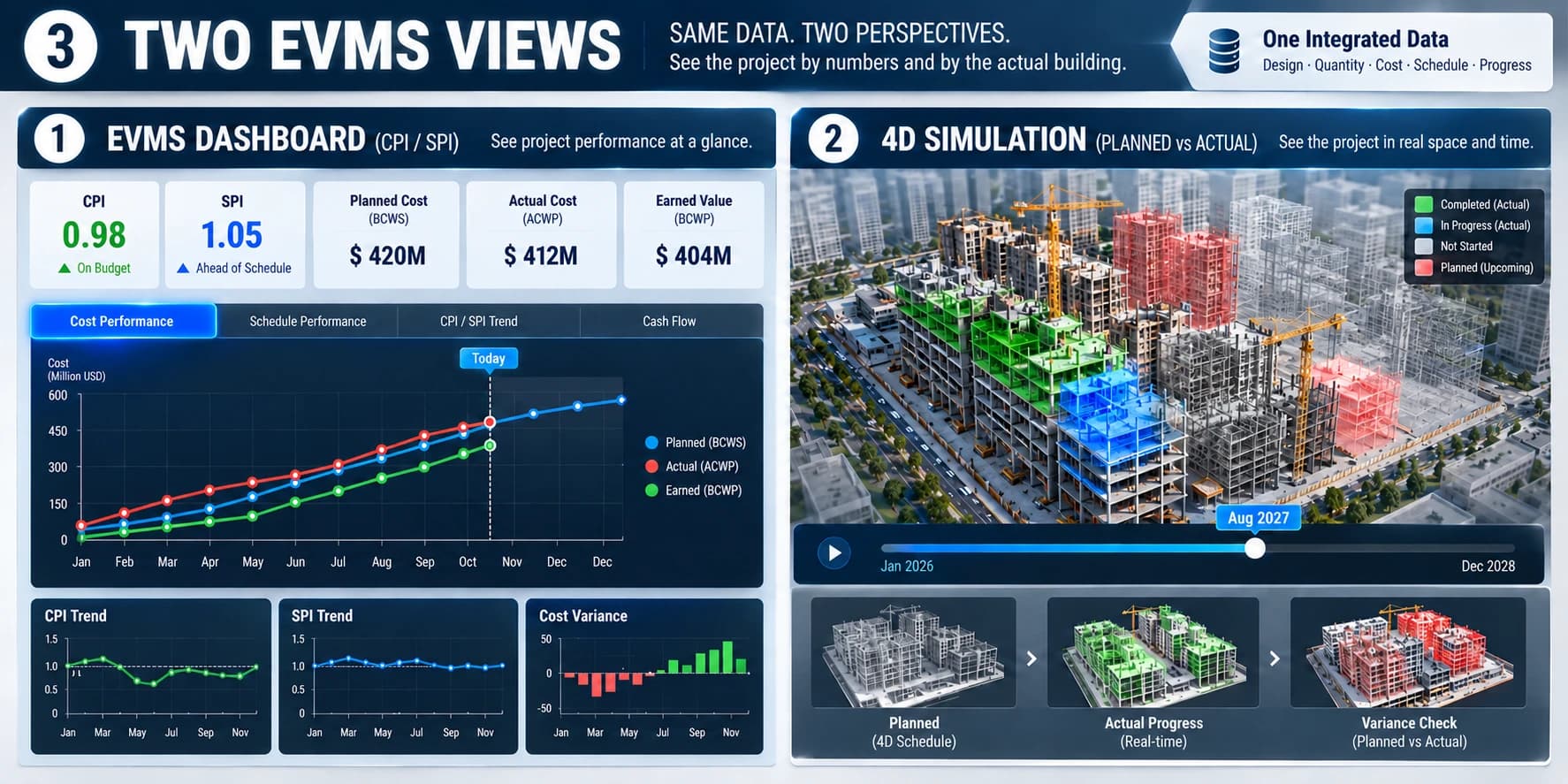
Same data. Two ways to see the project.
The EVMS dashboard shows performance as numbers: CPI, SPI, and planned, earned and actual cost. The 4D simulation shows the same project in space and time: what should stand on a given date, and what actually stands.
Both views are read from one integrated dataset, so they agree. That agreement is what shows the integration is real.
The Integration Burden
A design change is rarely one change.
A revised drawing can trigger model revision, quantity remeasurement, estimate recoding, schedule relinking, progress review, report reproduction and another round of approvals. Every step may be valid work; the waste comes from rebuilding the connections between them.
That repeated, largely invisible burden appears as six hidden taxes.
The Six Hidden Taxes
The cost is not only software or labor. It is time discarded between decisions.
These are not accounting taxes. They are recurring operational costs created when project meaning, evidence and responsibility are fragmented.
| Hidden tax | When it begins | Time and work discarded | Downstream cost | What connected engineering changes |
|---|---|---|---|---|
| Re-entry Tax재입력 비용 | A drawing, model, quantity, estimate or schedule changes, but the connected systems do not share the same project state. | Teams re-enter the same information, rebuild mappings, remeasure quantities, recode estimates, reconnect activities and reproduce reports. | More handoffs, more opportunities for mismatch, and less time for engineering judgment. | Keep related deliverables connected to one engineering state so affected information can be updated without rebuilding the entire chain. |
| Latency Tax지연 비용 | A change or field condition is discovered after cost, schedule or procurement options have narrowed. | Teams wait for periodic reconciliation, then spend additional time locating which reports and models are current. | Decisions arrive after cheaper or safer alternatives have closed, increasing the cost of response. | Shorten the interval between a verified change and its visible downstream impact across quantity, cost, schedule and project controls. |
| Expertise Tax전문인력 소모 비용 | Scarce specialists must repeatedly compare files and correct routine inconsistencies before they can make a professional judgment. | Senior time is consumed by checking identifiers, copying values, resolving version confusion and preparing the same evidence again. | Review capacity becomes the bottleneck, while judgment, mentoring and risk management receive less attention. | Systemize repeatable checks and preserve exceptions for trained Metomers and responsible engineers to review. |
| Semantic Tax의미 불일치 비용 | The same physical object carries different names, identifiers, classifications or states across tools and teams. | People rebuild the meaning of each object at every handoff and manually decide which records refer to the same thing. | Quantity, cost, schedule and model views drift apart even when each individual tool is working correctly. | Maintain shared object identity and engineering context across the deliverables that describe it. |
| Evidence Tax근거 복원 비용 | A reviewer, auditor, owner or project team asks why a number, state or decision existed at a particular time. | The team searches emails, old models, spreadsheets, approvals and meeting records to reconstruct the basis after the fact. | Audit and change review slow down, and confidence falls when the calculation basis or approval path cannot be reproduced. | Carry source, version, calculation basis and review status with the engineering state from the start. |
| Dispute Tax분쟁 비용 | Fragmented records leave parties with different accounts of scope, change, responsibility, progress or cost. | Time moves from delivery into claims preparation, responsibility arguments, contractual interpretation and legal review. | Commercial relationships deteriorate, decisions stall and downstream legal cost can exceed the original coordination effort. | Make changes, affected states and approvals traceable enough to support an evidence-based conversation before disagreement escalates. |
Scroll sideways to read the full table.
A Different Production Architecture
Connect the work before trying to automate more of it.
01
One engineering state
BIM, quantity, cost, schedule and project-control information refer to the same objects and approved project state.
02
Affected data is recalculated
A verified change is traced to the information it affects. Related quantities, costs, schedule states and views can then be recalculated without blindly changing everything.
03
Human Verification remains visible
Repeatable calculations are systemized. Ambiguity, exceptions and professional approval remain with trained Metomers and responsible engineers.
04
Evidence travels with the result
Sources, versions, calculation basis and review status stay traceable so a team can understand not only the result, but why it is the current result.
Comparable-Scope Benchmark
confirmed delivery example
Measure the same input, scope and acceptance standard.
In delivered work, connected engineering delivery that conventionally takes about 30 days has been completed in about 4, a larger scope of about 60 days in about 7, and a 20-plus-day quantity takeoff in about 2–3 days with 3D verification.
To see it on your own project, run a defined benchmark or PoC: agree the source set, required deliverables, review criteria and change scenario, then compare elapsed production time, re-entry, traceability and output quality.
Customer Value
Spend less project time rebuilding context—and more time making accountable decisions.
Less repeated data entry and reconciliation
Faster impact analysis after design change
More current cost, schedule and project-control information
Specialist time focused on judgment instead of file repair
Clearer evidence for review, audit and handover
A reusable engineering lineage across project stages